
Jean-Michel Jarre has transformed electronic music into a visual and spatial experience. Throughout his career, his concerts have occupied squares, monuments and large urban spaces, establishing a dialogue between music, technology, architecture and landscape.
Jean-Michel Jarre and the Mediterranean
Jean-Michel Jarre’s relationship with large spaces is one of the most recognisable characteristics of his work. His music is not limited to the stage; instead, it seeks to integrate its surroundings through light, projections, lasers and new technologies.
The Mediterranean offers precisely these kinds of settings: open cities, monumental architecture, night-time landscapes and a light that transforms spaces. From this perspective, Jarre’s concerts can be understood as a way of reinterpreting the territory through sound and image.
The work of Jean-Michel Jarre undoubtedly belongs to this second category. From Oxygène and Équinoxe, electronic music ceased to be simply a succession of sounds and became an experience in which light, architecture, landscape and imagination also play a part.
FROM MONACO TO SEVILLE: TWO LANDSCAPES, ONE WORK
Monaco and Seville are very different settings. The former is directly connected to the sea and the Mediterranean coastal landscape; the latter looks inland through the Guadalquivir and a history deeply connected to Mediterranean exchanges.
Nevertheless, in both cases Jean-Michel Jarre uses space as an essential element of his artistic approach.
Music ceases to be an exclusively sonic experience and becomes a visual, architectural and territorial experience.
Along this journey, Monaco and Seville represent two particularly interesting moments through which to understand this relationship with the Mediterranean. Two different settings, yet united by the same approach to spectacle: turning space into part of the music.
Monaco: MUSIC OVER THE HARBOUR
Monaco represents one of the most distinctive Mediterranean settings in Jean-Michel Jarre’s career. The city-state, situated between the Alps and the Mediterranean, brings together architecture, sea, light and modernity within a compact space.
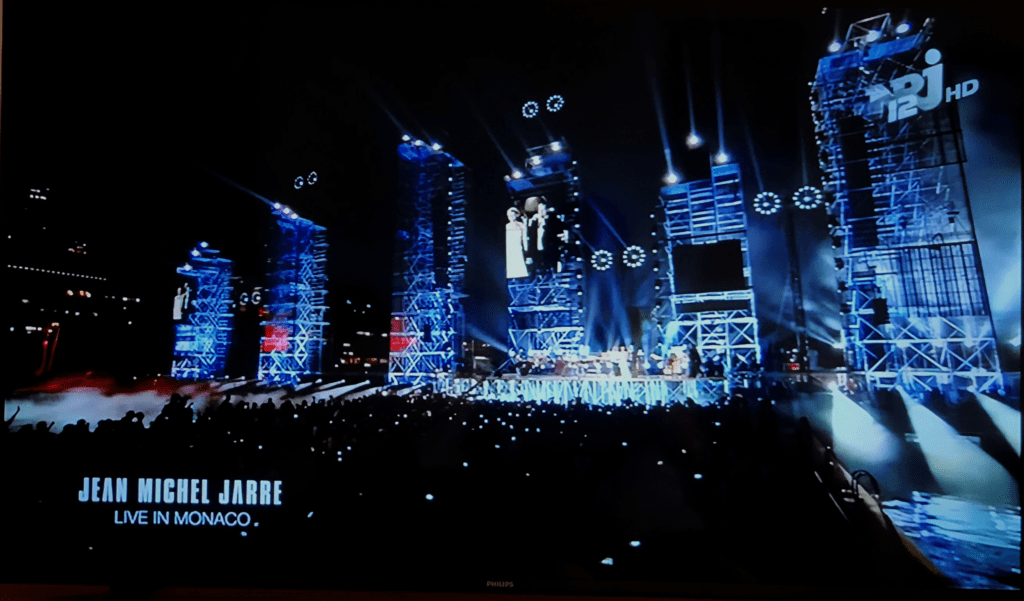
The concert Live in Monaco, at Port Hercule, on 1 July 2011, illustrates this spectacular dimension of his work. It was also connected to a historic event involving the Princely Family.
The Mediterranean setting becomes a vast stage, while electronic music, projections and lighting effects alter the perception of the landscape.
More than a simple concert, the experience proposes a fusion of music, architecture and technology, a formula that Jean-Michel Jarre has developed over decades.
One of the most spectacular examples took place in Monaco, at Port Hercule, on 1 July 2011.
Jarre presented a major spectacle on the occasion of the wedding of Prince Albert II and Charlene. For several hours, the harbour became a huge stage of light, sound, projections and technology.
It was not a conventional concert as part of a tour. The spectacle was presented on the occasion of their wedding.
- It was free and open to the public, with the harbour and the heights of Monaco transformed practically into a giant stage.
- Jarre designed a large-scale production, with a stage structure approximately 200 metres wide, lighting, lasers, video and pyrotechnics.
- Albert II and Charlene appeared on stage and presented the spectacle, a detail that fits precisely with what you remembered.
- Musically, it combined classics such as Oxygène, Équinoxe, Rendez-Vous and Chronologie with elements specifically related to the wedding, including an electronic wedding march.
- Jarre also performed “Vintage”, dedicated to the newlyweds and presented live at the time.
Seville: A CONCERT IN FRONT OF HISTORY
The journey from Monaco to Seville takes us to another type of setting. Seville is not a coastal Mediterranean city, but it belongs to the same culture and geographical universe of southern Europe. The Guadalquivir, its architecture and its historical connection with the Mediterranean make the city a particularly significant setting.
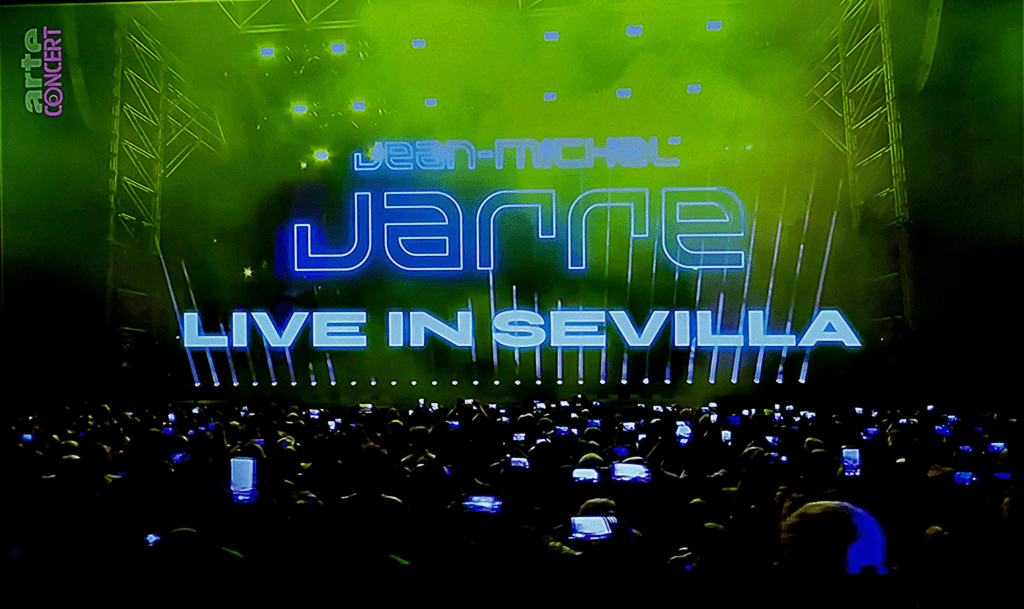
Jean-Michel Jarre’s concert in Seville on 8 July 2025 represents this ability to bring contemporary electronic music into a space steeped in history.
The city is transformed during the spectacle. Music, lights and projections create a contrast between the technology of the 20th and 21st centuries and an urban heritage built over many centuries.
In this way, Seville once again becomes much more than the place where a concert is held: it becomes part of the audiovisual work, following his previous performance in the city in 1993.
The repertoire included some of Jarre’s fundamental works, among them Oxygène, Équinoxe, Rendez-Vous and Les Chants Magnétiques.
In Monaco, this resulted in a particularly Mediterranean combination: sea, architecture, night and light, brought together with one of the great figures of electronic music.
Technology as an Artistic Language
From his earliest works, Jean-Michel Jarre has explored the possibilities of technology applied to music. His large-scale spectacles have expanded this exploration by incorporating projections, lighting, lasers and other audiovisual resources.
This combination allows each concert to be different according to the place where it takes place. Architecture and landscape cease to be a simple backdrop and become part of the visual composition of the spectacle.
This is where his work connects particularly with ArtMediterranean’s perspective: interpreting the territory through art.
21st-century technology thus encountered architecture conceived more than a century ago.
Light on the ceramics.
Projections across the architecture.
Electronic music in front of a historic space.
And, in the background, the Andalusian sky.
A Mediterranean Journey Through His Work
From Monaco to Seville, Jean-Michel Jarre’s journey allows us to observe the same idea through different landscapes.
The sea, cities, light, architecture and technology form part of a language that transcends the boundaries between music and visual arts.
Therefore, rather than speaking only about concerts, we can speak of a way of creating landscape through music.
Jean-Michel Jarre turns large spaces into stages, but he also transforms them into experiences. And it is precisely in this relationship between music, place and imagination that we can find his particular vision of the Mediterranean.
The Mediterranean Is Not Only Seen. It Is Also Heard.
Jean-Michel Jarre demonstrates that electronic music can leave the studios, cross decades of technological innovation and encounter something as ancient as the landscape.
In Monaco, the sea. In Seville, the architecture. In both cases, the light.
And between them, a music that continues to seek new spaces in which to be heard.
Because perhaps the Mediterranean is not only a place.
Perhaps it is also a way of perceiving the world.
And some music knows how to find it.
Web References on Jean-Michel Jarre
- Official Jean-Michel Jarre website — main reference for his career, current activities and projects.
- Official Jean-Michel Jarre biography — artistic career, concerts and musical development.
- Monaco Concert 2011 — the official biography documents the concert-spectacle created by Jarre in the Principality of Monaco on the occasion of the wedding of Prince Albert II.
- ARTE Concert — Jean-Michel Jarre: Live in Seville — recording of the 2025 concert at Plaza de España in Seville, with a duration of 93 minutes.
- Official Jean-Michel Jarre YouTube channel — concerts, music videos and audiovisual material.
- Official discography — information about Oxygène, Équinoxe, Rendez-Vous, Oxymore and the rest of his work.
- Jean-Michel Jarre on Spotify — discography, albums, singles and recordings available.
- Jean-Michel Jarre — Live in Seville — official video
Jean-Michel Jarre — Monaco — Port Hercules — official video